.png)
.png)
Background
Nuclear energy is an often-overlooked solution to decarbonizing the energy industry, the industry responsible for the most carbon emissions worldwide (Ge 2025). Although nuclear energy is not considered renewable due to its requirement of enriched radioactive material and its highly dangerous byproduct, a nuclear plant can provide massive amounts of energy while emitting zero carbon into the atmosphere. Additionally, nuclear energy is known as a base load energy: an energy source that can sustain a constant supply of energy as energy demands fluctuate throughout the day and year. Wind and solar energy cannot supply base-load energy without expensive energy storage solutions, leaving nuclear as one of the few options for zero-carbon base-load energy.
Germany, a highly developed country in central Europe, utilized nuclear energy for decades as one of its major sources of energy. Nuclear energy comprised approximately 10-15 percent of all energy from 1990 to 2010 (Frauenhofer ISE 2025). The country decided to abandon investment in nuclear energy in 2014 when elected officials decided to pursue “Energiewende,” or “Energy Turnaround.” The Energiewende plan included a goal for the country to reduce carbon emissions by 80 percent by 2050 by replacing coal, oil, and nuclear plants with predominantly wind and solar energy (World Nuclear Association 2021). Public sentiment had been trending away from nuclear energy in the 2000’s, and the 2011 Fukushima Nuclear Disaster in Japan is credited as a key reason why Energiewende included a phase-out of nuclear energy (Emblemsvåg 2024). Germany officially decommissioned its last nuclear power plant in 2023, marking an end to decades of the energy source.
Some academic literature shows that abandoning nuclear energy may be an economic and climate mistake on Germany’s part. One analysis found that Germany could have reduced carbon emissions by 73 percent on top of all other carbon emission reductions and spent half as much as Energiewende already has (Emblemsvåg 2024). Another study found that implementing a mix of nuclear and renewable energies was the most effective method to decarbonize energy when compared to nuclear or renewables alone (Saidi & Omri 2020). Further, another study found that increased nuclear energy is associated with economic growth and increased adoption of renewable energy (Wang 2023).
Given the urgency of the climate crisis and the ability of nuclear energy to provide large amounts of carbon-free energy, an analysis of potential carbon savings if Germany had not abandoned nuclear energy may provide a lesson to other countries considering phasing out nuclear energy. This analysis shows the potential carbon emission savings if Germany had maintained its existing nuclear energy profile before major cuts to nuclear energy began.
Methods
To assess nuclear energy’s potential to reduce Germany’s carbon emissions during its nuclear phase-out, a conservative estimate of nuclear energy output was assumed and compared to its annual energy sector carbon emissions.
Power use by energy source data from Frauenhofer ISE, a German-based solar energy research company, was utilized. ENTSO-E, AGEE-Stat, Destatis, Fraunhofer ISE, and AG Energiebilanzen were credited by Fraunhofer ISE as their data sources. The power sources were separated into three groups: renewable, nonrenewable, and nuclear. The five-year average (2010– 2014) of Germany’s nuclear power generation before major cuts were made to its nuclear program was calculated in terawatt hours (TWh). This five-year average is represented as a scenario in which Germany’s nuclear energy profile was maintained while all other energy generation remained the same. The average is a conservative estimate of potential nuclear power output because the 2010-2014 average is the lowest it has been in decades; it also excludes the possibility of increasing nuclear power output. This five-year average was extended to 2022, and the residuals between this average and Germany’s actual nuclear energy generation were calculated. These residuals were considered carbon-savings, because they represent carbon-free energy that could have been utilized instead of fossil fuels each year. The carbon savings were then calculated as a percent of all nonrenewable energy produced each year. These percentages are represented as the proportion of energy carbon emissions that could have been mitigated each year. Finally, these percentages were multiplied by Germany’s yearly energy carbon emissions to find the yearly potential carbon savings in Mt CO2 equivalent (Mt CO2e). The yearly energy carbon emission data were sourced from the World Bank’s World Development Indicators.
Result
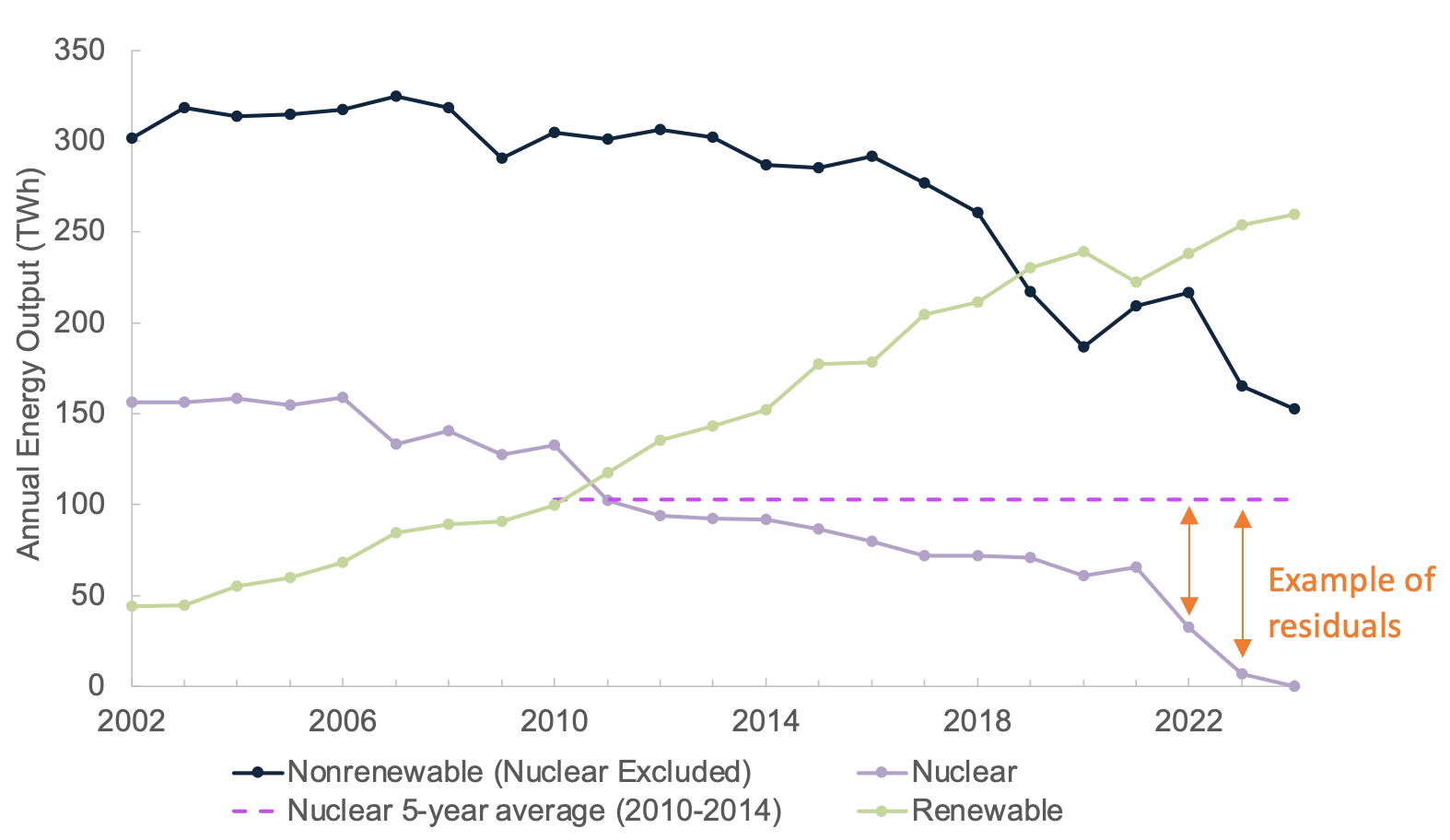
Figure 1: Germany’s energy production grouped into renewable, nonrenewable, and nuclear categories. Nuclear’s 2010-2014 average is extended to 2024, and examples of residuals are shown between the potential and actual nuclear power generations.
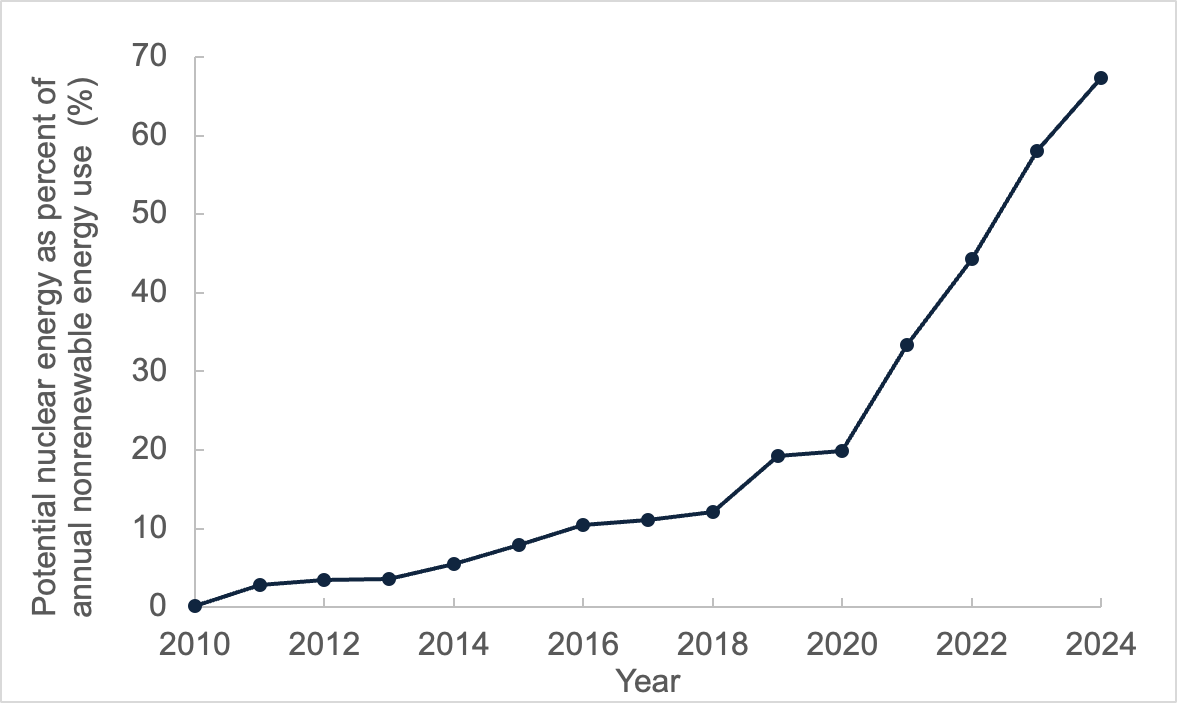
Figure 2: Percent yearly nonrenewable energy savings if replaced by the 2010-2014 nuclear power average.
|
Year |
Potential energy savings (TWh) |
Potential energy savings as % of nonrenewable energy |
Power industry Carbon emissions (Mt CO2e) |
Potential mitigated carbon emissions (Mt CO2e) |
|
2010 |
0.4 |
0.1 |
338.0 |
0.5 |
|
2011 |
8.5 |
2.8 |
330.9 |
9.3 |
|
2012 |
10.5 |
3.4 |
341.6 |
11.8 |
|
2013 |
10.9 |
3.6 |
346.3 |
12.5 |
|
2014 |
15.9 |
5.5 |
327.3 |
18.1 |
|
2015 |
22.6 |
7.9 |
322.6 |
25.6 |
|
2016 |
30.5 |
10.5 |
321.8 |
33.7 |
|
2017 |
30.8 |
11.1 |
303.9 |
33.8 |
|
2018 |
31.7 |
12.2 |
287.1 |
34.9 |
|
2019 |
41.7 |
19.2 |
239.1 |
46.0 |
|
2020 |
37.2 |
19.9 |
203.7 |
40.6 |
|
2021 |
69.9 |
33.4 |
233.1 |
77.9 |
|
2022 |
95.9 |
44.3 |
244.6 |
108.3 |
|
2023 |
95.9 |
58.1 |
174.0 |
101.1 |
|
2024 |
102.7 |
67.3 |
160.0 |
107.7 |
|
Total (2015-2024) |
609.42 |
Table 1: Nuclear energy’s possible energy and carbon savings if it were to replace nonrenewable sources.
Germany’s phase-out of nuclear power has significant implications for its energy mix and carbon emissions, as illustrated by the following analysis of potential generation, nonrenewable energy savings, and associated carbon reductions. Nuclear energy’s five-year average from 2010 to 2014 was found to be 102.6 TWh. This average, along with the country’s actual renewable, nonrenewable, and nuclear power generation, can be seen in Figure 1. Residuals from the actual and potential nuclear energy output can be found in Table 1. Savings of nonrenewable power start at 22.6 TWh in 2015 and grow to as large as 102.663 TWh in 2024, when nuclear generation reaches zero in Germany. The share of nonrenewable energy savings as a percent of nonrenewable energy production is shown in Figure 2 and Table 1. These figures show that nuclear generation could have replaced 7.9 percent of nonrenewable energy in 2015, growing to 67.3 percent by 2024. Yearly potential carbon savings can be found in Table 1. They range from 25.5 Mt CO2e in 2015 to 108.3 Mt CO2e in 2022. Total potential carbon savings from 2015 to 2024 were found to be 609.4 Mt CO2e.
Discussion
The results of this analysis reveal significant potential carbon savings if Germany maintained its nuclear energy output from 2010–2014 through to 2024. By phasing out nuclear energy, Germany passed on an opportunity to substantially reduce its reliance on nonrenewable energy sources and reduce carbon emissions. This finding has implications for other nations
grappling with the decision to retain or phase out nuclear energy in their decarbonization strategies. Additionally, less dependence on natural gas may have put Germany in a better position to transition away from Russian natural gas once the Ukraine War started.
The calculated residuals highlight the increasing role nuclear energy could have played in replacing nonrenewable energy sources. The percentage of nonrenewable energy savings increased very quickly over the eight years past 2014. This is due to less nonrenewable energy being produced; the amount of potential nuclear energy is held constant. The associated carbon savings are significant, totaling 609.4 Mt CO2e over the analyzed period. These emissions savings are substantial; they exceed Germany’s total carbon emissions in 2023, 582.95 Mt CO2e.
These findings do not undermine the value of renewable energy investments but instead emphasize the limitations of relying exclusively on renewables without energy storage solutions or alternative base-load energy sources. Wind and solar cannot solely supply base-load energy easily, despite being critical components of a decarbonized energy portfolio. The integration of nuclear energy could have provided a stable, zero-carbon foundation for Germany’s energy transition while renewable technologies continue to mature.
Nuclear energy is not being abandoned worldwide; however, Germany’s neighbor, France, generates approximately 70 percent of its annual energy from nuclear energy, and China generated 434 TWh of nuclear energy in 2023 (World Nuclear Association 2025). Advancements in nuclear technology have made it cleaner, safer, and oftentimes more economically viable than ever. Much of today’s innovation in nuclear energy today comes in the form of small modular reactors, or SMRs. SMRs are smaller nuclear reactors that have lower power output than previous generations of nuclear energy, but come with smaller upfront costs and infrastructure footprints, reduced nuclear fuel requirements, and enhanced safety features compared to large reactors (Liou 2023). An economic analysis of SMR technology found that SMRs have a higher cost per unit of energy compared to a large nuclear reactor, but have smaller upfront costs due to their smaller footprint and modular expansion capabilities (Van Hee 2024). One barrier to large nuclear reactors is their high upfront cost and lengthy time of construction, so SMRs would alleviate these two concerns while retaining all other benefits of nuclear energy.
For other nations considering phasing out nuclear energy, Germany’s experience serves as a cautionary tale. Countries facing similar energy challenges should carefully weigh the trade-offs between safety concerns, energy portfolio needs, and the tangible benefits of nuclear energy in achieving decarbonization goals. This analysis shows the need for a diverse energy portfolio that includes nuclear energy as a carbon-free, base-load energy.
Works Cited
Emblemsvåg, J. (2024). What if Germany had invested in nuclear power? A comparison between the German energy policy the last 20 years and an alternative policy of investing in nuclear power. International Journal of Sustainable Energy, 43(1).
Frauenhofer ISE. (2025). Energy Charts. Frauenhofer ISE. Retrieved November 7, 2025.
Ge, M., Friedrich, J., & Vigna, L. (2024, December 5). Where Do Emissions Come From? 4 Charts Explain Greenhouse Gas Emissions by Sector. World Resources Institute.
Saidi, K., & Omri, A. (2020). Reducing CO2 emissions in OECD countries: Do renewable and nuclear energy matter? Progress in Nuclear Energy, 126(1), 103425.
Liou, J. (2023, September 13). What Are Small Modular Reactors (SMRs)? International Atomic Energy Agency; IAEA Office of Public Information and Communication.
Nick Van Hee, Peremans, H., & Philippe Nimmegeers. (2024). Economic potential and barriers of small modular reactors in Europe. Renewable and Sustainable Energy Reviews, 203(114743).
Wang, Q., Guo, J., Li, R., & Jiang, X. (2023). Exploring the role of nuclear energy in the energy transition: A comparative perspective of the effects of coal, oil, natural gas, renewable energy, and nuclear power on economic growth and carbon emissions. Environmental Research, 221, 115290.
World Bank. “World Development Indicators.” The World Bank, Retrieved November 7, 2025.
World Nuclear Association. (2021, May 27). Germany’s Energiewende - World Nuclear Association. World-Nuclear.org.
World Nuclear Association. (2025a, October 24). Nuclear Power in China - World Nuclear Association. World-Nuclear.org.
World Nuclear Association. (2025b, October 23). Nuclear Power in France - World Nuclear Association. World-Nuclear.org; World Nuclear Association.