Procurement is one of the most influential yet underutilized mechanisms for advancing sustainability in higher education. Universities purchase food, electronics, construction services, furnishings, travel, apparel, laboratory supplies, and professional services, and those purchases carry environmental and social consequences across institutional supply chains. Yet implementation remains uneven and difficult, and many institutions struggle to turn sustainability commitments into routine purchasing decisions.
To explore why, American University professors Sarah Iverson and Nicole Darnall and Sustainability Manager Anna Parse Johnson led a workshop, “Accelerating Sustainable Procurement Impact Through Community Engagement,” at the 2025 Association for the Advancement of Sustainability in Higher Education (AASHE) Conference in Minneapolis. The 105-minute session took place on October 23, 2025. It brought together 24 participants: about 82% from public and private colleges and universities, and the rest vendors and representatives of business associations. Roles ranged from sustainability directors and procurement staff to facilities leaders, finance executives, and consultants.
Rather than focusing on high-level goals, the workshop emphasized the operational realities of procurement. It combined live polling, procurement systems mapping, small-group dialogue, and collaborative idea generation. The initiative was grounded in a research-practice partnership among American University’s Procurement Office, Office of Sustainability, and faculty researchers.
From Commitment to Practice: How Institutions Buy
The workshop used American University’s procurement systems map as a discussion tool to help participants compare institutional structures and identify operational frictions. Their conversations showed that sustainable procurement is shaped by a web of factors: governance structures, purchasing centralization, budget authority, leadership priorities, staff expertise, vendor relationships, policy, data systems, and culture.
A clear structural pattern emerged. Large purchases are generally centralized and subject to procurement oversight, while smaller purchases are often spread across departments, administrative units, laboratories, offices, and cardholders. Where authority is concentrated, sustainability standards can be built into contracts and supplier relationships. Where it is dispersed, visibility and accountability decline and sustainability expectations become inconsistent.
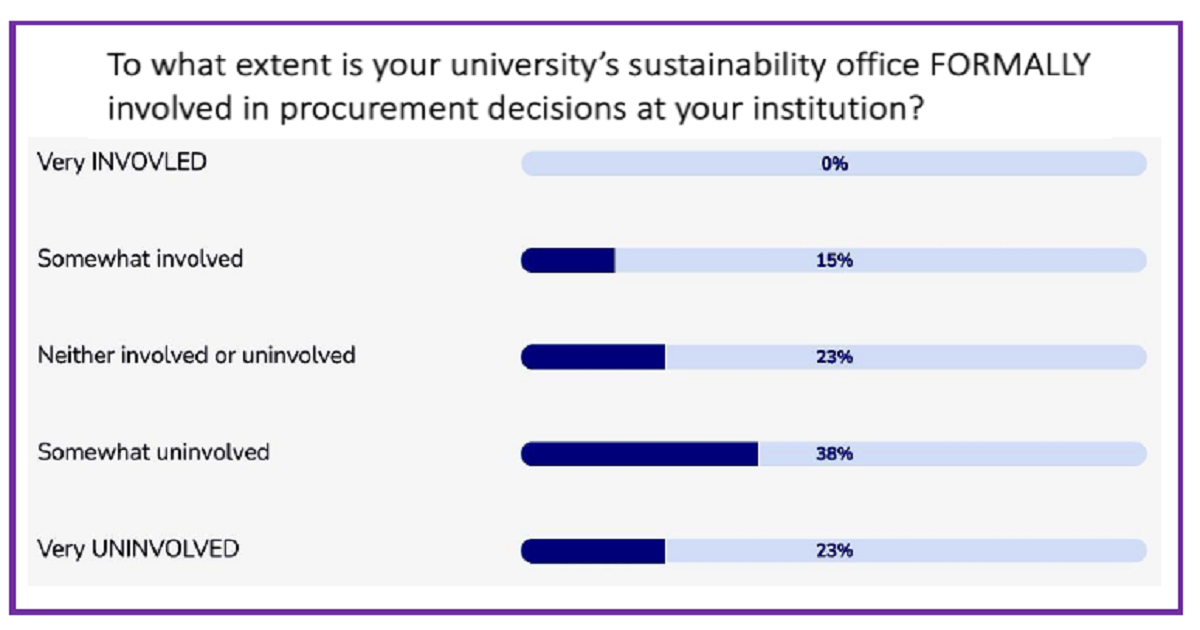
Sustainability offices, meanwhile, frequently play advisory roles. Participants described them as under-resourced and often consulted late, after key decisions have been made, with little influence over contracting, supplier selection, or purchasing approvals. In the workshop poll on sustainability office involvement, no one chose “involved,” 15% said “somewhat involved,” 23% said “neither involved or uninvolved,” 38% said “somewhat uninvolved,” and 23% said “uninvolved.”
Leadership support also varied widely across campuses. Where it was strong, participants described greater coordination and stronger policy. Where it was inconsistent or symbolic, implementation was fragmented. Participants did not express resistance to sustainable procurement. Their concern was institutional capacity: whether their organizations can build systems that translate sustainability aspirations into practice.
Understanding the Barriers: Organizational Frictions
Barriers named in the polling clustered around decentralization, budget constraints, limited staffing, insufficient procurement authority, weak communication across units, competing institutional priorities, and resistance to change. These resembled the themes found in American University’s own research.
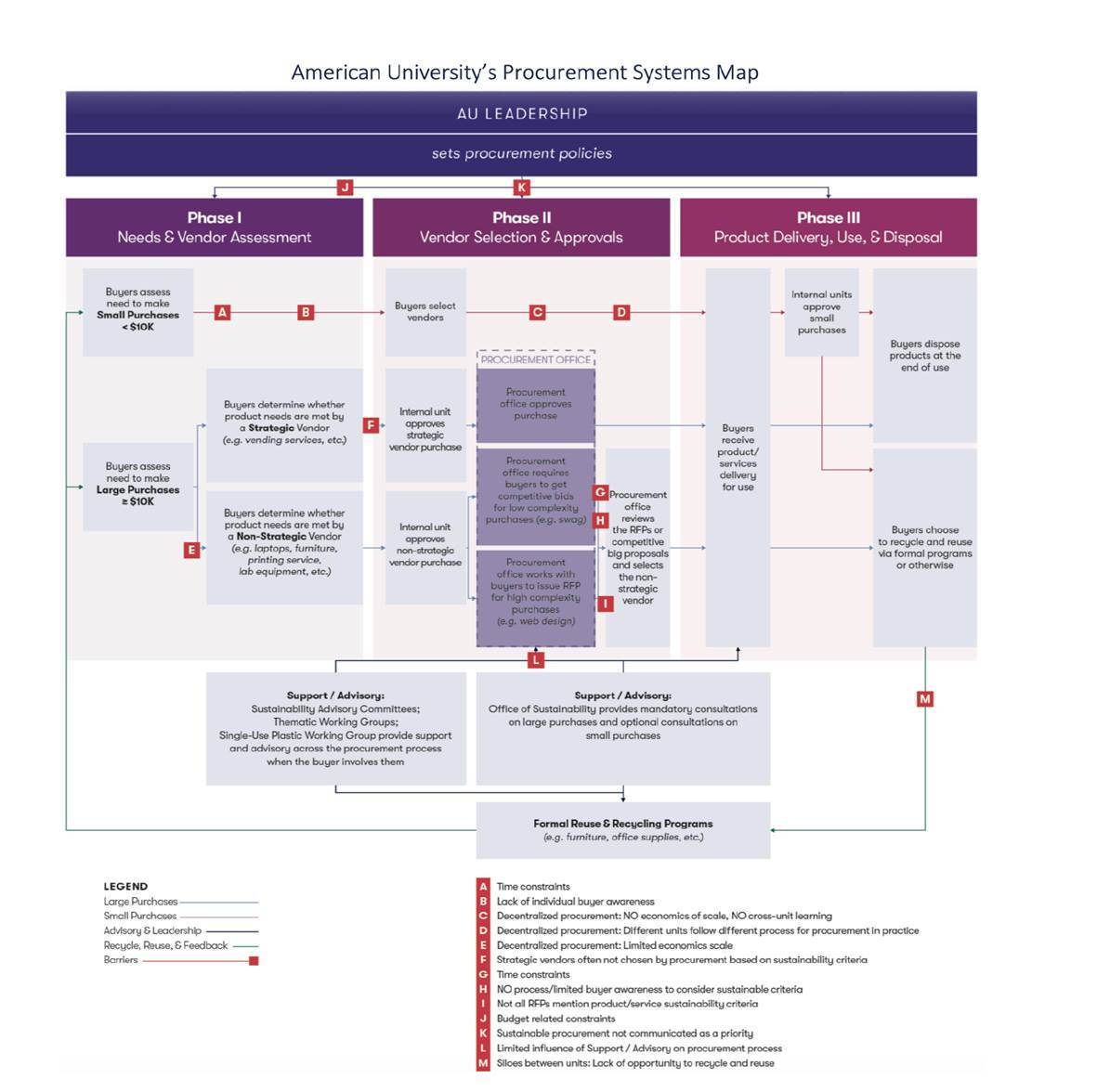
Participants rarely framed the barriers as technical. Fragmented governance meant purchasing decisions occur across many units with different sustainability expectations and levels of procurement knowledge. Many staff who make routine purchases receive limited guidance, so convenience, familiarity, or short-term cost can win out. Sustainable products are often perceived as more expensive, and procurement systems frequently prioritize immediate price minimization. Leadership turnover and shifting priorities can stall momentum.
Importantly, the same barriers appeared across institutions with different governance structures, sizes, and locations. That consistency suggests many of these challenges are systemic across higher education rather than specific to one campus.
Moving to Action: What Participants Propose
The workshop closed with idea-generation exercises. Participants worked in groups to cluster ideas, prioritize opportunities, and identify practical actions. Their proposals center on five areas:
- Formalization. Embed sustainability criteria in contracts, supplier evaluations, purchasing guidelines, and workflows, instead of relying on individual champions or informal networks.
- Cross-functional collaboration. Use joint committees, integrated review processes, and shared metrics to connect procurement, sustainability, finance, and facilities teams.
- Education and tools. Provide training, guidance tools, purchasing checklists, and peer learning.
- Supplier engagement. Use purchasing power through supplier sustainability scorecards, vendor disclosures, preferred supplier programs, and collaborative purchasing.
- Leadership. Secure executive sponsorship and public accountability, and start with small, strategic actions that build momentum.
Looking ahead: Building a Community of Practice
Participants expressed strong interest in continuing to share strategies and resources across institutions, and in communities of practice that support shared learning, resource exchange, benchmarking, and joint problem-solving. Because institutions face similar barriers, the report sees substantial opportunity for collective learning and coordinated action.
Strategic Recommendations for Higher Education Institutions
Several recommendations emerge from the workshop:
- Treat sustainable procurement as an organizational systems issue, not solely a purchasing one. Isolated operational projects are unlikely to succeed.
- Strengthen integration between procurement offices and sustainability functions. Sustainability expertise and procurement authority often remain disconnected.
- Prioritize standardization and formalization. Embedding criteria in policies, contracts, purchasing systems, and evaluation frameworks can institutionalize sustainable purchasing.
- Invest in education and capacity building. Employees across decentralized purchasing systems need clearer guidance and decision-support tools.
- Keep executive leadership engaged. Resources, legitimacy, and accountability sustain momentum.
- Build communities of practice for shared learning and benchmarking across institutions.
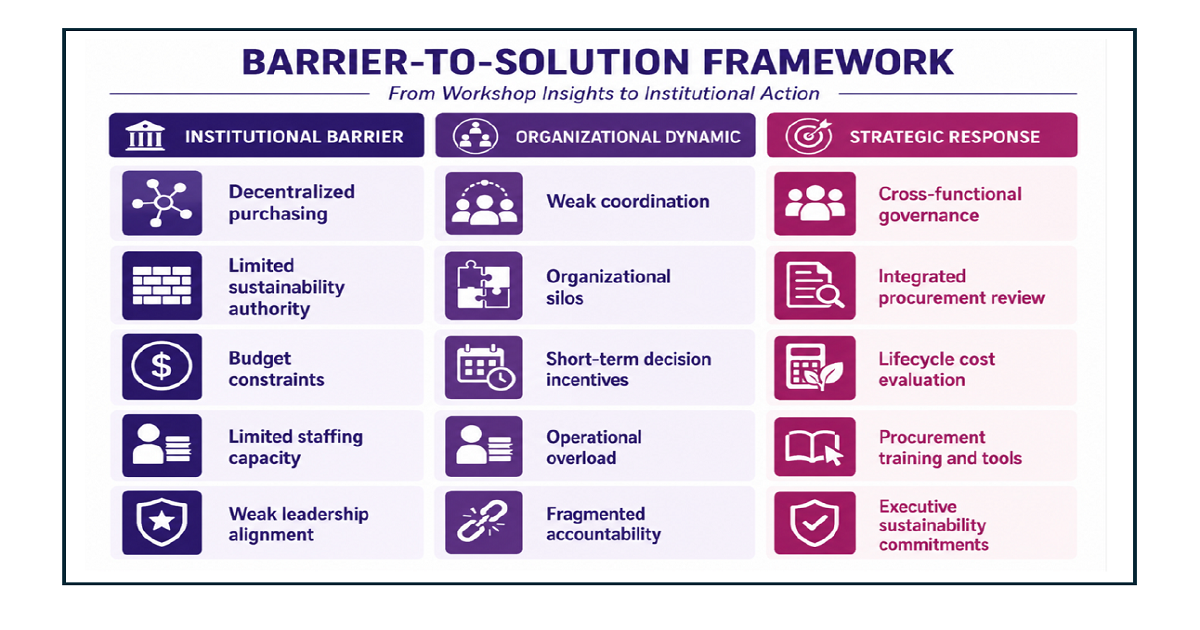
The report’s Barrier-to-Solution Framework ties these recommendations to the barriers. Each institutional barrier is paired with an organizational dynamic and a strategic response: decentralized purchasing and weak coordination point to cross-functional governance; limited sustainability authority and organizational silos point to integrated procurement review; budget constraints and short-term decision incentives point to lifecycle cost evaluation; limited staffing capacity and operational overload point to procurement training and tools; and weak leadership alignment and fragmented accountability point to executive sustainability commitments.
Conclusion
The workshop shows both the complexity and the urgency of sustainable procurement in higher education. Procurement systems influence institutional emissions, supply-chain impacts, labor conditions, and waste, yet they often remain fragmented and difficult to transform. Progress requires more than sustainability commitments: stronger governance, clearer accountability, operational integration, and sustained leadership engagement.
At the same time, participants showed real momentum for change, with interest in collaborative learning and practical implementation. As the report puts it, sustainable procurement is not simply about changing what institutions buy, but about transforming how institutions organize decision-making, define value, coordinate operational systems, and align purchasing with long-term sustainability priorities.
The authors note that the workshop was small and voluntary, relied on self-reported perceptions, and took place at a sustainability conference, so the findings are exploratory and not statistically representative.
Read the Report
Download the full report: Accelerating Sustainable Procurement Impact in Higher Education (2026), by Garima Sharma, Sarah Iverson, and Nicole Darnall.
This research was funded by the Translating Research into Action Center (TRAC) at American University. Early collaboration was catalyzed by the Center for Environment, Community, and Equity (CECE). Special thanks to Anna Parse Johnson for her collaboration during the workshop.