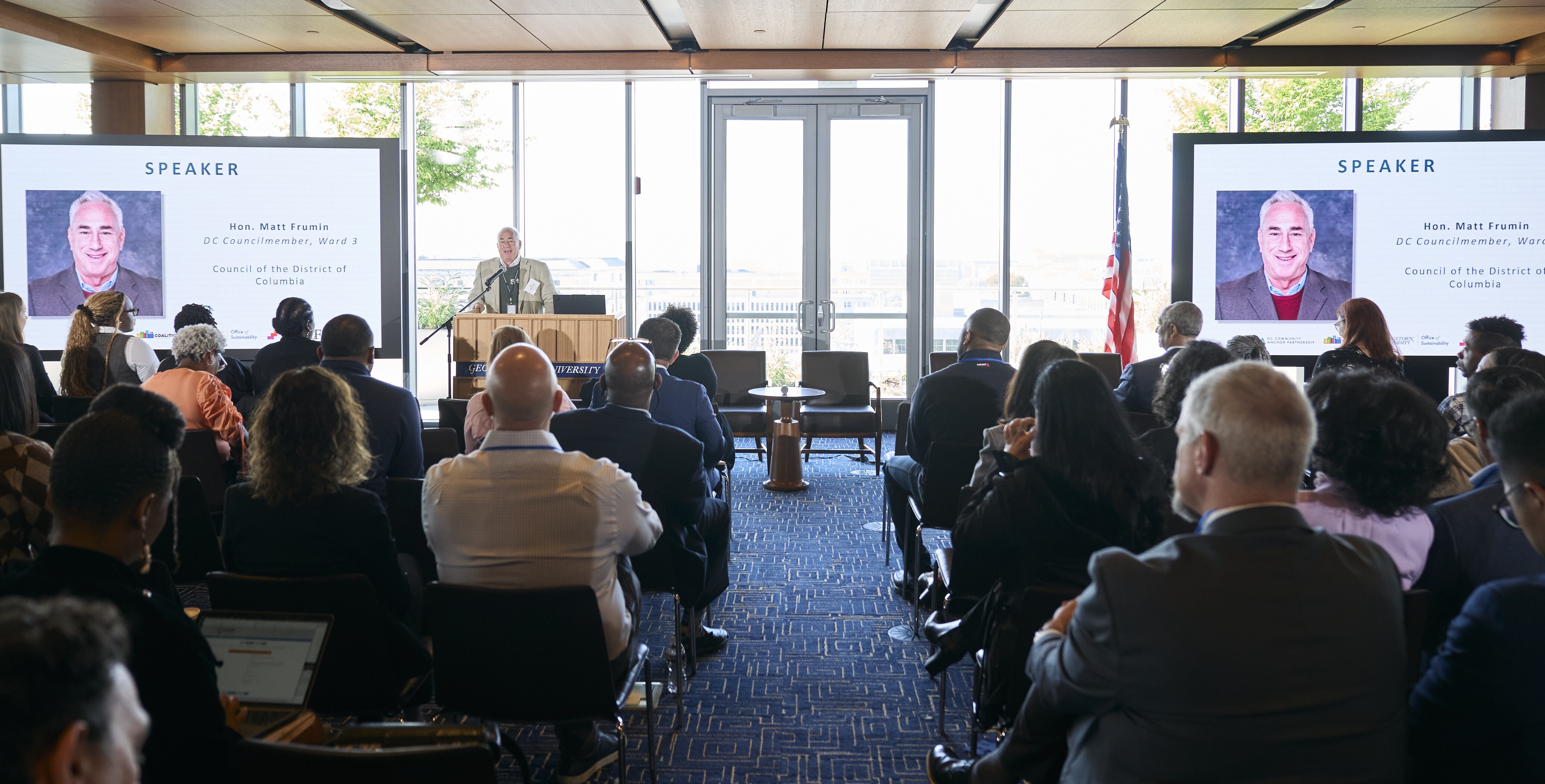
American University professors Garima Sharma (Kogod School of Business), Sarah Iverson (College of Arts & Sciences), and Nicole Darnall (Kogod School of Business, School of Public Affairs) led a research-driven discussion at the DC Anchor Community Partnership’s (DCAP) “Vendor Connection Day” workshop, working alongside DCAP leaders and participants to examine how procurement can better support local economic inclusion. The workshop created a space where procurement officers, institutional leaders, and vendors could engage directly with research insights while reflecting on their own practices. Drawing on their ongoing research into how organizations adopt sustainable procurement, the team focused the discussion on the organizational barriers and decision-making dynamics that shape purchasing outcomes in practice.
This collaboration directly supports DCAP’s mission. As a public-private partnership led by The Coalition and co-convened with the DC Office of the Deputy Mayor for Planning and Economic Development, DCAP seeks to redirect the more than $2 billion that DC universities and hospitals spend annually toward locally owned businesses. Yet, despite this scale, only a small share of that spending reaches local and diverse suppliers. The workshop made clear that this gap is not simply a matter of intent—it reflects how procurement systems are structured and how decisions are made within them.
 Within this context, the workshop centered on sustainable procurement as a practical pathway forward. By integrating environmental and social criteria into purchasing decisions, institutions can use existing procurement systems to advance multiple objectives simultaneously.
These include reducing environmental impacts—such as Scope 3 emissions, which account for 50–80% of higher education’s carbon footprint—while also expanding opportunities for local and diverse suppliers. Framed this way, sustainable procurement becomes not an added requirement, but a mechanism for aligning institutional spending with DCAP’s goals of inclusive economic growth.
From Awareness to Integration: Where Institutions Stand
The workshop’s live polling results reveal that most institutions have begun to engage with sustainable procurement, but few have fully embedded it into their systems.
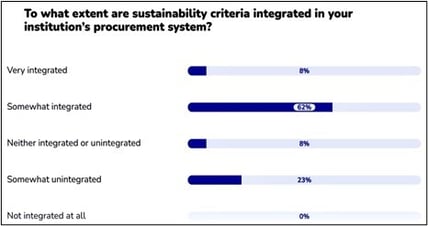 A clear majority (62%) reported that sustainability is “somewhat integrated” into their procurement systems, while only 8% indicated that it is “very integrated.” At the same time, 23% described their systems as “somewhat unintegrated,” and another 8% reported a neutral position.
American University professors Garima Sharma (Kogod School of Business), Sarah Iverson (College of Arts & Sciences), and Nicole Darnall (Kogod School of Business, School of Public Affairs) led a research-driven discussion at the DC Anchor Community Partnership’s (DCAP) “Vendor Connection Day” workshop, working alongside DCAP leaders and participants to examine how procurement can better support local economic inclusion. The workshop created a space where procurement officers, institutional leaders, and vendors could engage directly with research insights while reflecting on their own practices. Drawing on their ongoing research into how organizations adopt sustainable procurement, the team focused the discussion on the organizational barriers and decision-making dynamics that shape purchasing outcomes in practice.
This collaboration directly supports DCAP’s mission. As a public-private partnership led by The Coalition and co-convened with the DC Office of the Deputy Mayor for Planning and Economic Development, DCAP seeks to redirect the more than $2 billion that DC universities and hospitals spend annually toward locally owned businesses. Yet, despite this scale, only a small share of that spending reaches local and diverse suppliers. The workshop made clear that this gap is not simply a matter of intent—it reflects how procurement systems are structured and how decisions are made within them.
Within this context, the workshop centered on sustainable procurement as a practical pathway forward. By integrating environmental and social criteria into purchasing decisions, institutions can use existing procurement systems to advance multiple objectives simultaneously.
These include reducing environmental impacts—such as Scope 3 emissions, which account for 50–80% of higher education’s carbon footprint—while also expanding opportunities for local and diverse suppliers. Framed this way, sustainable procurement becomes not an added requirement, but a mechanism for aligning institutional spending with DCAP’s goals of inclusive economic growth.
From Awareness to Integration: Where Institutions Stand
The workshop’s live polling results reveal that most institutions have begun to engage with sustainable procurement, but few have fully embedded it into their systems.
A clear majority (62%) reported that sustainability is “somewhat integrated” into their procurement systems, while only 8% indicated that it is “very integrated.” At the same time, 23% described their systems as “somewhat unintegrated,” and another 8% reported a neutral position.
Taken together, these findings point to a consistent pattern: institutions demonstrate broad awareness of sustainability goals, but they have not yet institutionalized those goals in procurement practice. Sustainability criteria may exist in principle, but they are not systematically embedded in decision rules, workflows, or incentive structures. As a result, only a small number of organizations have reached a level of maturity where sustainability meaningfully shapes purchasing outcomes.
This gap has direct implications for DCAP’s mission. The inclusion of local and diverse suppliers depends heavily on how procurement criteria are defined and operationalized. When sustainability and equity considerations remain loosely integrated, local vendors face structural disadvantages in competing for institutional contracts.
Understanding the Barriers: Organizational Frictions
The workshop and underlying research make clear that the primary barriers to sustainable procurement are not technical—they are organizational. Three categories of friction have consistently emerged in Sharma, Iverson, and Darnall’s research. First, leadership and direction remain uneven. Many participants pointed to the absence of clear mandates or strategic priorities, as well as limited executive signaling to procurement staff. Without strong direction from leadership, sustainability remains a secondary consideration rather than a core requirement.
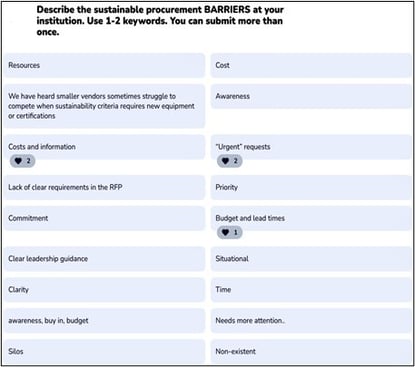 Second, education and capacity constraints persist. Buyers often lack the training needed to evaluate sustainability criteria or to assess vendors beyond cost considerations. This creates uncertainty and reinforces default behaviors that prioritize price and convenience. Third, procurement system design itself poses challenges. Existing systems tend to emphasize efficiency and cost minimization, with sustainability and local sourcing treated as add-ons rather than embedded features. In practice, this means that choosing sustainable or local vendors often requires additional effort, creating friction that discourages change.
Notably, participants’ reflections on barriers to DCAP participation mirrored aspects of these broader findings, reinforcing the conclusion that systemic design—not lack of intent—limits progress.
Moving to Action: What Participants Commit to Doing
Despite these barriers, participants identified a set of concrete short-term actions that signal both readiness and direction. These commitments cluster around three areas.
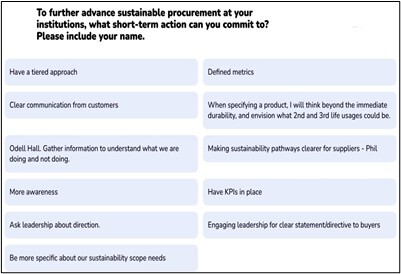
- Formalization. Participants emphasized the need for defined metrics, key performance indicators (KPIs), and tiered frameworks that translate sustainability goals into actionable criteria. This reflects a broader demand for measurement infrastructure that can guide decision-making and track progress.
- Clarity and communication. Participants called for clearer articulation of sustainability expectations—both internally among buyers and externally to suppliers. This includes specifying scope requirements and making sustainability pathways more transparent for vendors.
- Leadership engagement. Participants recognized that advancing sustainable procurement requires stronger direction from institutional leadership. Calls to “ask leadership about direction” and “engage leadership for clear directives” highlight the importance of top-down commitment. At the same time, there are signs of conceptual evolution. Some participants emphasized life-cycle thinking—considering second and third product uses—indicating a shift from transactional purchasing toward a more systems-oriented perspective.
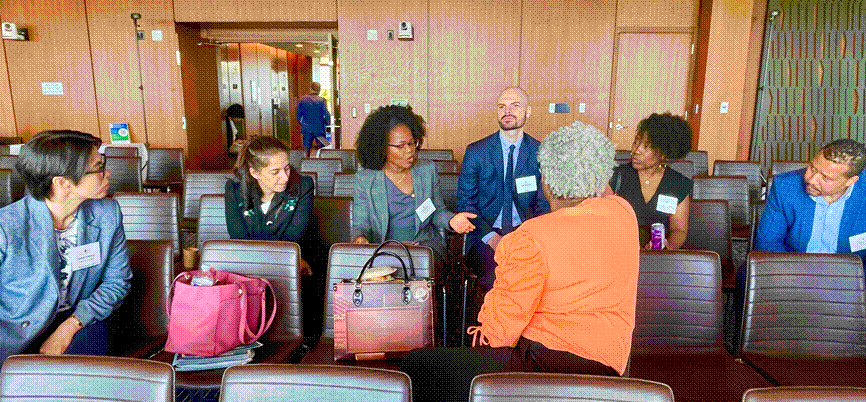
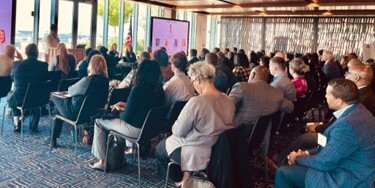
Image: Workshop breakout session
Looking Ahead: Building a Collective Agenda
The final polling exercise focused on future goals for the DCAP network, revealing a shared vision for collective progress.
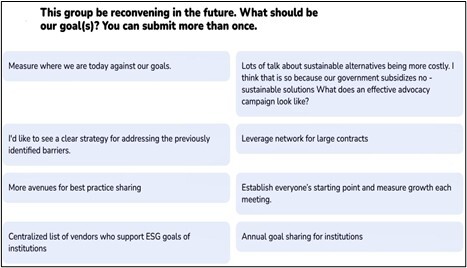 Participants expressed strong interest in developing shared measurement and benchmarking systems, including establishing baseline metrics and tracking growth over time. This reflects a desire for accountability and comparability across institutions.
They also emphasized the need for clearer strategies to address persistent barriers, particularly those related to cost perceptions and policy constraints. Addressing these issues will require coordinated, cross-institutional efforts rather than isolated initiatives.
Importantly, participants highlighted the potential of network-based procurement power. Suggestions such as leveraging collective demand for large contracts and creating centralized lists of ESG-aligned vendors align directly with DCAP’s role as a platform for aggregation and coordination.
During our discussions, there was a clear call for expanded knowledge-sharing infrastructure. Participants want more opportunities to exchange best practices and to align around shared goals on an ongoing basis. This positions DCAP not only as a convening body, but as a mechanism for learning, diffusion, and continuous improvement.
Strategic Implications for DCAP
Several conclusions emerge from the workshop:
- The primary constraint is institutional design rather than intent. Organizations are not resistant to sustainable or local procurement; they lack the systems, metrics, and mandates needed to implement it consistently.
- Procurement represents a critical intersection between sustainability and inclusion. Decisions that reduce environmental impacts—such as lowering emissions—can simultaneously support local economic development by expanding opportunities for diverse suppliers. DCAP sits squarely at this intersection.
- Network effects remain underutilized. Participants clearly recognize the value of shared vendor databases, aggregated demand, and coordinated contracting. These are areas where DCAP can deliver unique value.
- There is an immediate opportunity to standardize tools and frameworks. ESG checklists, KPIs, and tiered procurement models can reduce implementation barriers and accelerate adoption across institutions.
Conclusion
The workshop underscores a pivotal moment. DC institutions are ready to align procurement with sustainability and local economic inclusion, but they are not yet equipped to do so at scale.
For DCAP, the path forward involves embedding sustainability and local sourcing into procurement systems, equipping buyers with the necessary tools and metrics, and leveraging collective purchasing power to elevate DC-based vendors. If successfully implemented, this approach has the potential to transform procurement from a compliance function into a powerful engine for regional economic development, fully advancing DCAP’s mission.
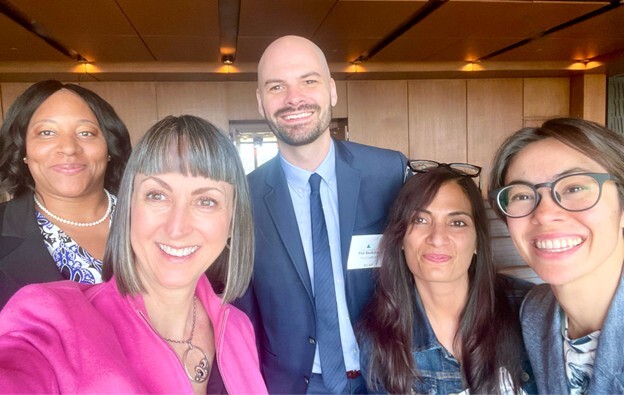 Image: Ayana Thomas (Associate Vice President, Georgetown University), Nicole Darnall (Professor, American University), Phil Berkaw (Senior Director, The Coalition), Garima Sharma and Sarah Iverson, (Assistant Professors, American University)