.png)
Kogod School of Business
What is Kogod’s Case Competition?
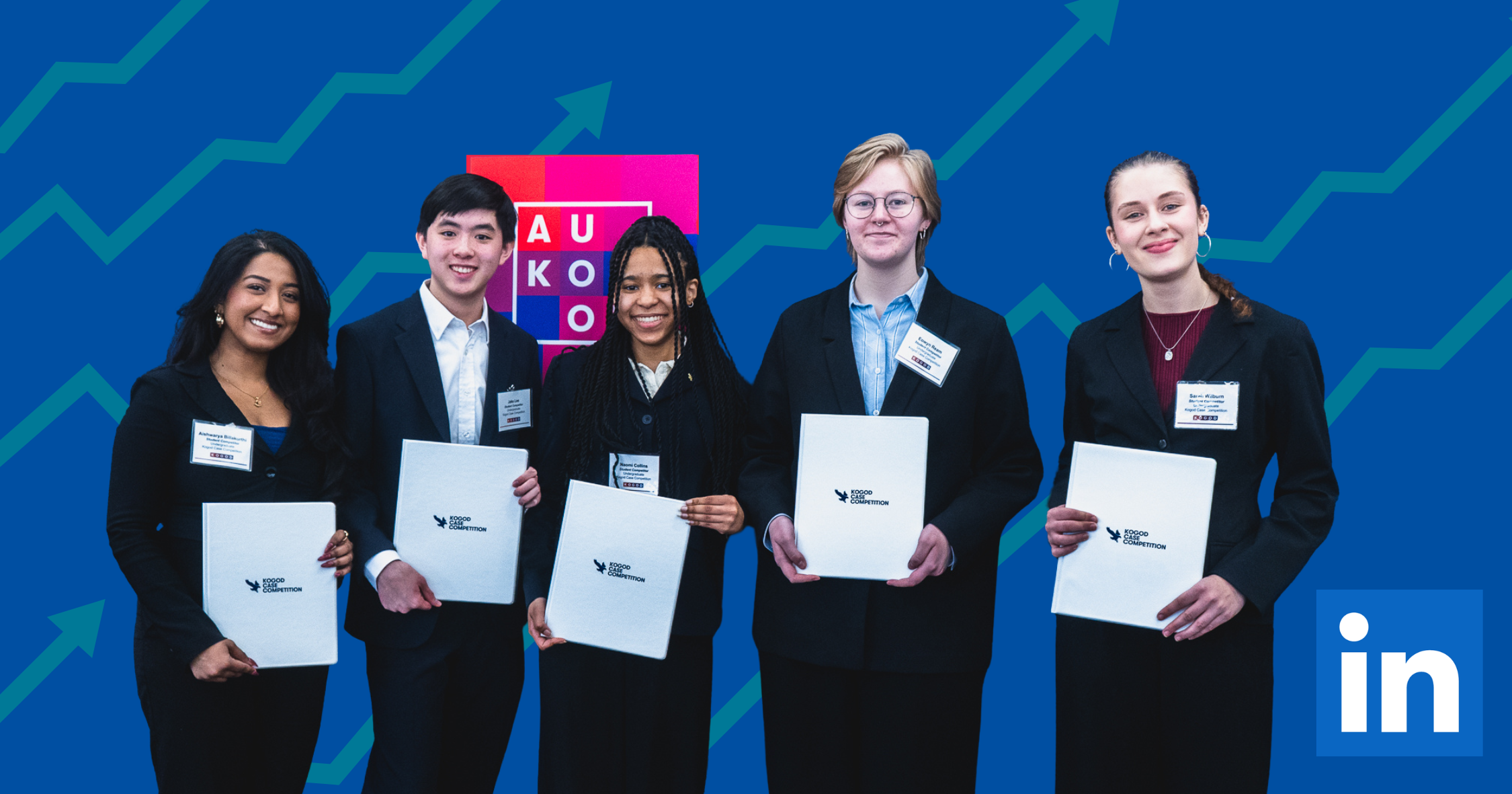
The Kogod School of Business’s annual Case Competition is a national business challenge where student teams develop solutions to real-world problems using industry data and strategic analysis.
In 2026, Kogod partnered with LinkedIn to focus on a critical question:
How artificial intelligence and skills-based hiring are reshaping the future of work.
Fifty teams from universities across the country participated, building solutions grounded in real labor market data and presenting them to industry judges, including judges from LinkedIn as the partner organization.
The 2026 Kogod Case Competition: Building LinkedIn’s Work Chart Economy Model
The 2026 Case Competition centered on designing a “Work Chart Economy”—a model that prioritizes skills over job titles.
Students were asked to explore:
- How AI is changing hiring and workforce planning
- How workers can transition across industries more effectively
- How organizations can identify and measure skills more accurately
- How education systems can better align with workforce needs
The goal was not just to analyze trends, but to propose practical, scalable solutions.
Data Deep-Dive: How Students Used LinkedIn Data to Develop Workforce Solutions
A defining feature of the competition was its use of LinkedIn’s Economic Graph, which provided real-time workforce insights.
Students analyzed:
- in-demand and emerging skills
- talent movement across industries
- hiring and recruitment patterns
This data allowed teams to move beyond theory and build evidence-based strategies that reflect how the labor market is actually evolving.
The Shift to Skills-based Hiring
Across student pitch submissions, one throughline consistently emerged:
The future of work is increasingly defined by skills rather than job titles.
Students highlighted several implications of this shift:
- Employers need better tools to identify and evaluate skills
- Workers need clearer ways to communicate transferable experience
- Career paths are becoming more flexible and non-linear
This reflects a broader transformation toward skills-based hiring, where demonstrated capability matters more than traditional credentials.
What Solutions Did Students Propose to LinkedIn?
Winning teams focused on how AI can support workforce mobility and improve job matching. Top projects included:
AI-powered skills matching for displaced workers
One graduate student team from AU developed a solution designed to help displaced workers—particularly federal employees—transition into new roles.
“Our case proposed an AI-powered skills-matching tool that translates workers’ experience and education into in-demand skills,” said team members Daniela Castaneda Pinzon (Kogod BAAI ’26) and Jordan Taylor Hasty (Kogod MSM). “The goal is to help displaced federal employees connect with new roles beyond traditional job titles.”
They emphasized implementation alongside innovation:
“With a two-person team in the final round, we combined our strengths under tight time constraints to design a practical solution and build a clear, data-informed roadmap.”
Translating “trapped skills” across industries
The winning graduate student team, also from AU, focused on how professionals can better signal their skills when changing careers.
“Our solution helps LinkedIn users convert their ‘trapped skills’ into industry-relevant language for the field they want to pivot into,” said teammates Yousef Auer (Kogod MBA ’27), Varon Victor Miranda (Kogod MBA ’27), Matthew Rodenberg (Kogod MBA ’27), and Snehin Kannan (Kogod MS Finance ‘27).
Their proposal included:
- two product offerings
- a regional pilot in the DMV area
- a framework for improving skill visibility to employers
Together, these ideas demonstrate how AI tools can reduce friction in career transitions.
Takeaways From the 2026 Case Competition on the Future of Work
The competition highlights several important trends shaping the future of work:
- AI is transforming how organizations hire and manage talent
- Skills-based hiring is becoming a dominant workforce strategy
- Data is essential for understanding labor market shifts
- Career pathways are becoming more flexible and dynamic
For both students and employers, these insights point to a more adaptive and transparent workforce model.
Why Experiential Learning Matters in Business Education
The Case Competition is part of Kogod’s broader focus on applied learning—translating classroom knowledge into real business solutions.
During the final round of the case competition:
- more than 60 industry professionals and alumni served as judges
- students presented and defended their strategies
- teams received direct feedback from practitioners
This format helps students build both analytical and professional skills in a high-stakes environment—similar to what students can expect in their jobs after graduation.