DC universities and hospitals spend more than $2 billion a year, yet only a small share reaches local and diverse businesses. A workshop led by American University researchers with the DC Community Anchor Partnership found that the gap reflects how procurement systems are built, and that sustainable procurement offers a practical pathway forward.
The DC Community Anchor Partnership (DCAP), a public-private partnership led by The Coalition and co-convened with the DC Office of the Deputy Mayor for Planning and Economic Development, wants more of that money to go to locally owned businesses. So far, only a small share reaches local and diverse suppliers.
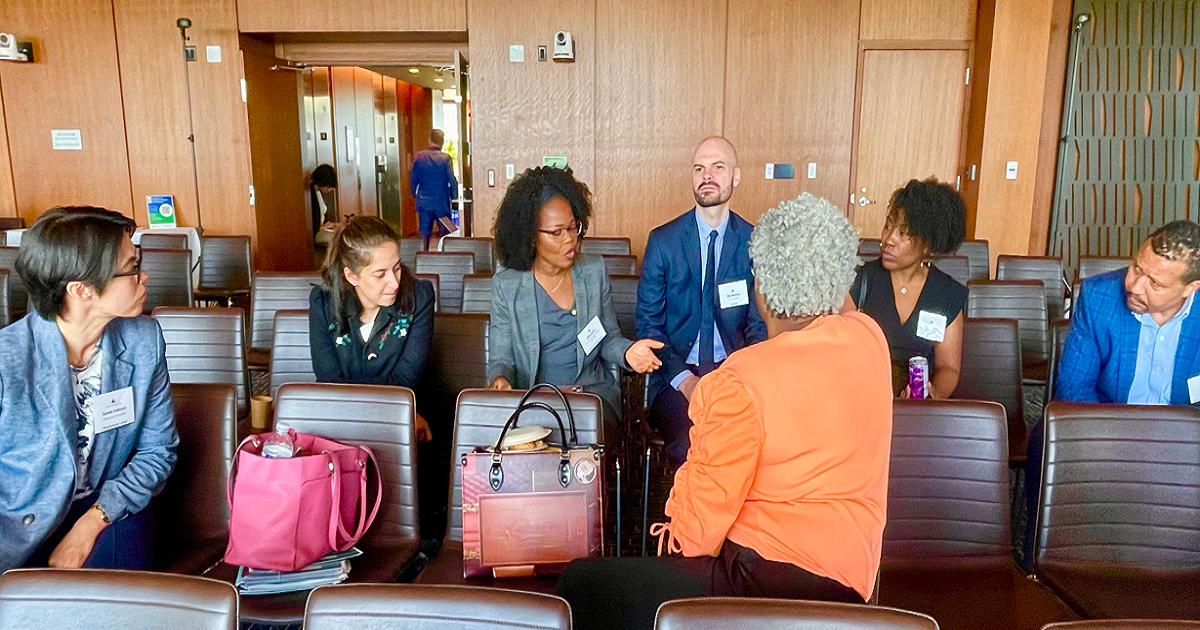
At DCAP's Vendor Connection Day, American University professors Garima Sharma, Sarah Iverson, and Nicole Darnall led a research-driven discussion with procurement officers, institutional leaders, and vendors about the organizational barriers and decision-making dynamics that shape purchasing outcomes. The workshop made clear that the gap is not simply a matter of intent. It reflects how procurement systems are structured and how decisions get made inside them.
Two goals, one lever
Building environmental and social criteria into purchasing lets institutions pursue several goals at once: cutting impacts such as Scope 3 emissions, which make up 50–80% of higher education's carbon footprint, and expanding opportunities for local and diverse suppliers. Sustainable procurement becomes not an added requirement but a mechanism for aligning spending with DCAP's goals of inclusive economic growth.
Most institutions have started. Few have finished
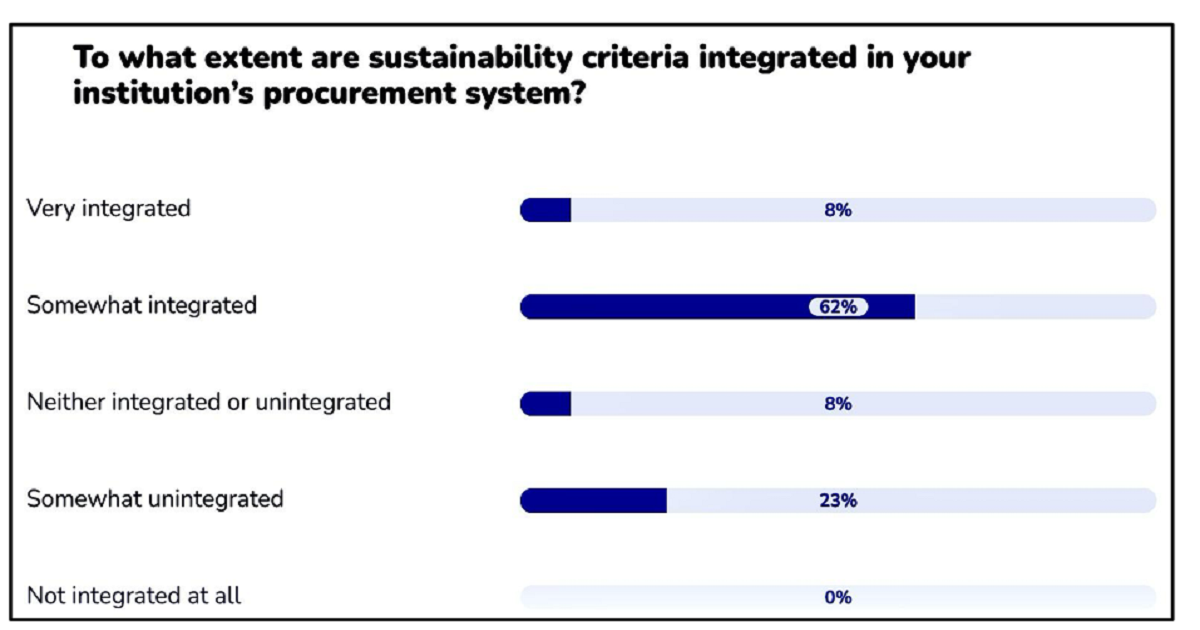
Live polls asked how far sustainability has been built into procurement. Sixty-two percent said it is "somewhat integrated." Only 8% said "very integrated." Another 23% called their systems "somewhat unintegrated," and 8% were neutral.
Awareness is broad, but sustainability is not yet embedded in decision rules, workflows, or incentive structures, so only a small number of organizations have reached a level of maturity where it meaningfully shapes purchasing outcomes. When sustainability and equity considerations stay loosely integrated, local vendors face structural disadvantages competing for institutional contracts.
The obstacles are organizational
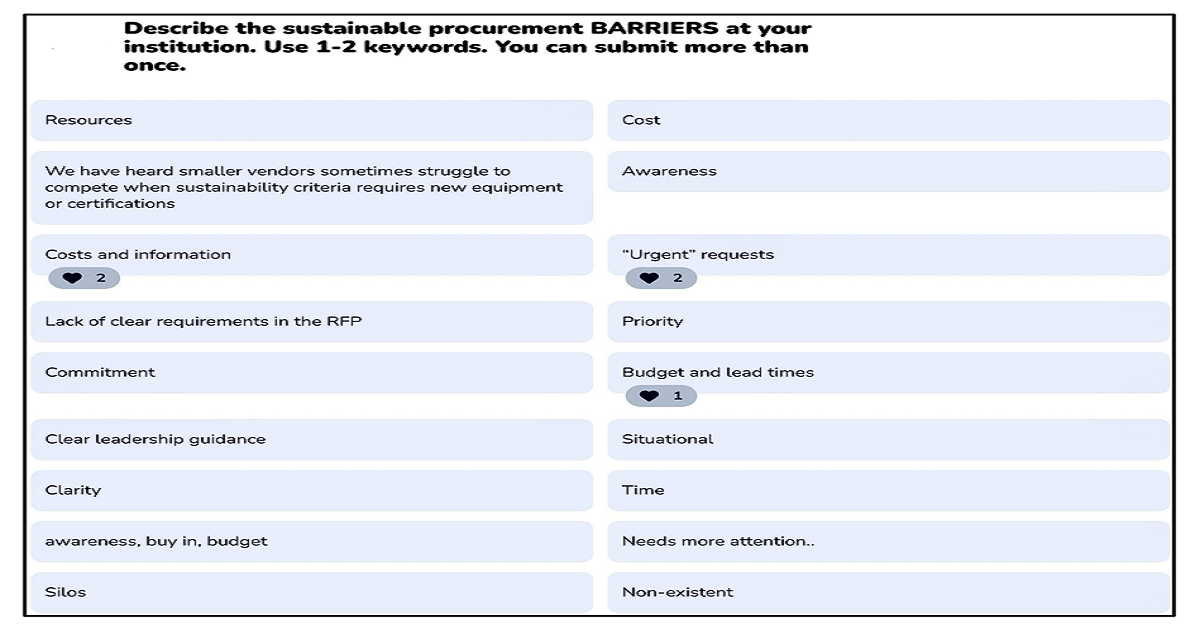
The primary barriers are not technical. They are organizational:
- Leadership and direction. Unclear mandates and limited executive signaling keep sustainability a secondary consideration rather than a core requirement.
- Education and capacity. Buyers often lack the training to evaluate sustainability criteria or assess vendors beyond cost, so price and convenience become the default.
- Procurement system design. Systems emphasize efficiency and cost minimization and treat sustainability and local sourcing as add-ons, so choosing those vendors takes extra effort.
Participants' reflections on barriers to DCAP participation mirrored aspects of these findings: system design, not lack of intent, limits progress.
What participants said they would do
Participants identified concrete short-term actions: defined metrics, KPIs, and tiered frameworks; clearer sustainability expectations for buyers and suppliers; and stronger direction from leadership, including calls to "ask leadership about direction" and "engage leadership for clear directives."
A shared agenda for the network
Looking ahead, participants wanted shared measurement and benchmarking, clearer strategies on cost perceptions and policy constraints, and more knowledge-sharing. They also saw potential in network-based procurement power, such as collective demand for large contracts and centralized lists of sustainability-oriented vendors, which aligns with DCAP's role as a platform for aggregation and coordination.
What it means for DCAP
The report draws these implications for DCAP:
- The primary constraint is institutional design rather than intent. Organizations lack the systems, metrics, and mandates to implement sustainable or local procurement consistently.
- Network effects remain underutilized. Shared vendor databases, aggregated demand, and coordinated contracting are areas where DCAP can deliver unique value. Procurement also sits at the intersection of sustainability and inclusion, and DCAP sits squarely at that intersection.
- There is an immediate opportunity to standardize tools and frameworks. ESG checklists, KPIs, and tiered procurement models can reduce implementation barriers and accelerate adoption across institutions.
Conclusion
The workshop underscores a pivotal moment. DC institutions are ready to align procurement with sustainability and local economic inclusion, but they are not yet equipped to do so at scale. The path forward involves embedding sustainability and local sourcing into procurement systems, equipping buyers with tools and metrics, and leveraging collective purchasing power to elevate DC-based vendors. If successfully implemented, this approach could transform procurement from a compliance function into a powerful engine for regional economic development.
Read the Report
Scaling for Impact: Sustainable Procurement at American University(ies) (2026), by Nicole Darnall, Garima Sharma, and Sarah Iverson.
This research project was carried out in partnership with The Coalition’s DC Community Anchor Partnership. It builds on collaborations initiated through seed funding from the Center for Environment, Community, and Equity (CECE) and the Translating Research into Action Center (TRAC) at American University.