.png)
A Note From the Author:
Heather has a close, personal connection with her research for this article. Throughout her childhood growing up in Pasadena, CA, she saw several wildfires blaze through the foothills of the San Gabriel Mountains, but out of reach of those communities at the edge of the foothills. The 2025 Eaton Fire crossed the boundary, devastating the communities in northern Altadena, just 15 minutes from her childhood home. Former classmates, family friends, and colleagues lost their homes in the fire. Heather’s coursework at American University has increased her interest in climate risk management and community resilience. As a result, for her final GIS project, Heather chose to focus her research on the impacts of wildfire-related climate risk on the insurance market in California and on how these impacts affect communities' recovery practices post-disaster. Her research highlights an alarming phenomenon occurring globally in places where climate change has increased the severity and frequency of natural disasters. Insurance, as it stands, is failing to serve as a form of climate adaptation, driving individuals, families, and entire communities into forced displacement and financial uncertainty. Her research seeks to bring awareness and highlight the urgency of this problem for the general public and policymakers, and the need for rapid, systemic change.
In January of 2025, Los Angeles experienced two of the most destructive wildfires in the state’s history. Starting in the Santa Monica and San Gabriel mountains, these fires eventually destroyed communities along the Wildland-Urban Interface (WUI), where there is a mix of wildland vegetation, homes, businesses, and other structures. Wildfires have become increasingly frequent and destructive across the western United States. Wildfires are a natural part of California’s landscape and burning provides ecological benefits, but increased variability in severe weather conditions and unprecedented droughts lead to extremely dry vegetation that is particularly flammable with the occurrence of extreme winds. Communities in and along WUI zones, which are subject to increased fire risk, are experiencing the most devastating consequences of California’s wildfires. (OEHHA, 2022). Additionally, California experienced a significant uptick in the number of homes in fire-prone parts of the state; between 1990 and 2020, the number of homes in WUI’s grew by 40 percent. People move into these areas for numerous reasons, including to be closer to nature or because homes are cheaper. Many California cities have restricted development in downtown areas, pushing people to the fringes of WUI zones to find affordable housing. The rapid growth of homes in WUIs increases the likelihood that wildfires will be increasingly devastating, as more properties, homes, and livelihoods are at risk (Rojanasakul & Plumer, 2025). Collectively, January 2025’s fires destroyed 16,246 structures and killed 31 people (CALFIRE, 2025). Post-fire, displaced individuals and communities face several difficult disaster recovery decisions, including temporary or permanent relocation and property reconstruction. To make matters worse, insurance market instability limits homeowners’ options, forcing them to make decisions that have long-term negative consequences on community resilience.
Wildfire damage is primarily covered through standard property and casualty insurance policies, also known as homeowners and renters’ insurance (Liao et al., 2022). Increases in wildfire-related losses create significant challenges for insurance markets, resulting in rising premiums and deductibles, declines in coverage, and policy cancellations (Dixon et al., 2018). If dropped by private insurance, homeowners can apply for the Fair Access to Insurance Requirements (FAIR) Plan, offered by the state of CA. FAIR Plan was intended as a “last resort” option for homeowners and provides limited coverage at substantially higher costs (Liao et al., 2022). Over the last few years, FAIR Plan’s exposure has increased significantly, from $50B in 2018 to $450B in 2025 (Costa, 2025). FAIR Plan is one disaster away from being unable to pay out sufficient claims, evidenced by the devasting property-related economic losses of the Eaton and Palisades fires, estimated around $52.5 billion. (Koller, 2025). Additionally, increasing stress on FAIR Plan could drive insurance companies to leave the state entirely, as risk on FAIR Plan is transferred to insurance companies in the risk pool. Policy cancellations, high premiums, and inadequate coverage exacerbate an already severe affordability crisis in California, burdening homeowners and having long-term impacts on community resilience and disaster recovery.
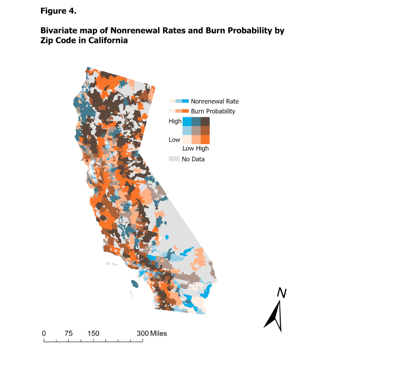
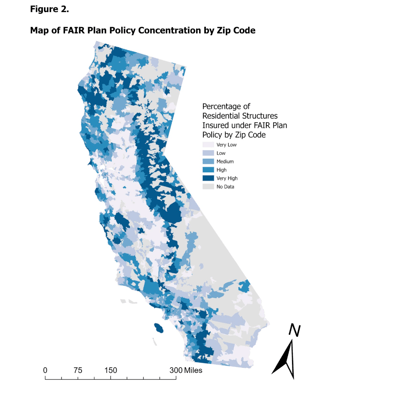
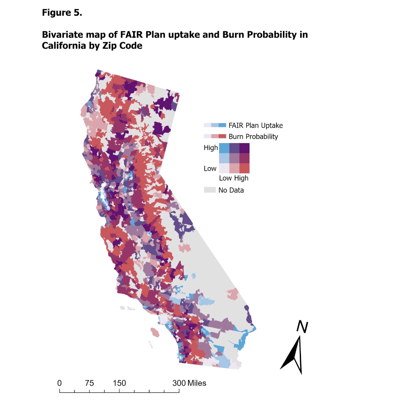
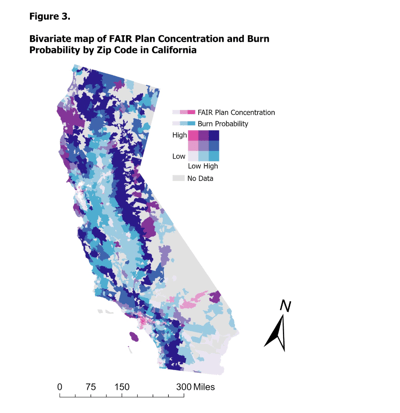
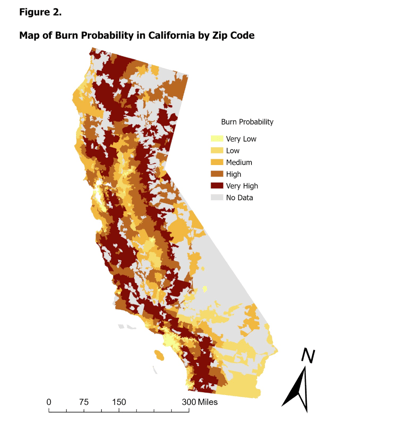
Living in a “high” risk climate zone already has significant implications for communities and individual’s livelihoods. If insurance coverage becomes increasingly unattainable, communities are left vulnerable to face the worst acute and long-term consequences of natural disasters. To highlight the relationship between climate risk and insurance coverage, datasets from the USDA Forest Service, the California Department of Insurance, and California FAIR Plan were obtained and transformed using ArcGIS Pro. The following variables, FAIR Plan policy concentration, insurance non-renewal rates, FAIR Plan uptake, and Wildfire Risk, were analyzed on a ZIP-code level to test for spatial correlation. Results show that areas with higher wildfire risk tend to be located near places with higher concentrations of FAIR Plan policies and higher rates of insurance policy non-renewals. Interestingly, high wildfire-risk areas show smaller increases in FAIR Plan enrollments, possibly because many homeowners can’t afford the plan and choose to go without insurance, or because those areas already had high participation in earlier years.
These findings support the broader conversation on climate risk and insurance coverage: homeowners are unable to secure adequate property insurance because insurers exclude high-risk ZIP codes or raise premiums to unaffordable levels, forcing homeowners to cancel policies and opt in to the FAIR Plan or self-insure. These results reinforce the data that shows FAIR plan policy count doubling between 2015 and 2023 in California. While this research highlights insurance instability in California, the findings are representative of broader global trends of climate risk, affordability, and climate-driven community displacement. A larger conversation must be had around the long-term consequences of community displacement and what this means for implementing equitable climate change adaptation strategies. For many, becoming a homeowner is a critical financial marker of success and stability, allowing families to build intergenerational wealth. Without insurance, one cannot obtain a mortgage or take the steps necessary to achieve this stability.
Furthermore, the insurance crisis delays rebuilding efforts and drives the long-term displacement of communities, as developers move in to purchase destroyed properties where homeowners can no longer afford to remain (Latino Policy & Politics Institute, 2025). These dynamics fragment communities, forcing homeowners into difficult decisions: either leave their homes due to looming wildfire risks and the lack of insurance coverage, or stay trapped because property values have plummeted and selling is no longer viable. In Altadena, post-Eaton Fire, progress in rebuilding highlights dynamics between disaster recovery and racial equity. A study by the Latino Policy & Politics Institute at UCLA analyzed property sales, permitting records, and rebuilding activity from February to August, 2025 to examine the progress made in wildfire recovery with a focus on whether racial disparities are emerging in who can rebuild and who is leaving the area altogether. In Altadena, which has historically higher rates of home ownership by households of color compared to the rest of the country, nearly half of those living in the burn area were people of color. The research shows that in Altadena, Black homeowners face the steepest hurdles to rebuilding after the Eaton fire, with 6 in 10 Black-owned homes severely fire-damaged. Additionally, investors have purchased two-thirds of the single-family homes with severe fire damage, which has significant implications for Altadena’s housing affordability. As of August 2025, nearly 70% of severely damaged homes have halted recovery progress, noting the delayed permitting process as the primary driver of slow progress, including financing gaps driven by insurance delays. This study highlights the nuances communities face post-disaster and how pre-existing racial and economic inequalities shape rebuilding efforts. Disaster recovery encompasses much more than the removal of physical debris. Many homeowners face financial barriers due to inadequate insurance and the high costs of reconstruction, and receive insufficient support navigating this landscape (Latino Policy & Politics Institute, 2025).
As wildfires increase in frequency and severity across the American West, insurance systems are struggling to meet the needs of communities facing mounting climate risks. To maintain access to coverage and reduce future losses, California must implement policies that incentivize physical risk reduction at the property level (Koller, 2025). Integrating climate resilience into planning and insurance regulation will be essential to reducing economic vulnerability. In Colorado, a proposed law would require insurance providers to consider government-funded wildfire protection improvements when determining policy pricing and coverage decisions (Costa, 2025). These state and local investments not only enhance public safety, but also have the potential to reduce the financial burden on residents. As climate disasters continue to threaten homes and livelihoods, insurance must function as more than a financial product. It should serve as a pillar of community resilience, supporting people as they navigate the changing realities of a warming world.
Appendix
Table 1
| Data | Description | URL |
|---|---|---|
| Percentage of Residential Structures Insured under a FAIR Plan Policy | The data included in the link below was provided by California admitted insurers and the FAIR Plan that wrote residential insurance pursuant to California Code of Regulation Title 10, Section 2646.6. The table provides the percentage of residential structures insured under a FAIR Plan policy by ZIP code. ZIP codes with less than 5 structures insured were excluded. Data is for calendar year 2022 and includes homeowners (excluding condominium), mobile home, dwelling fire owner- and tenant-occupied insuring structures with 4 or less units. Condominium complexes and structures of 5 or more units are insured under a commercial policy and are excluded. |
View Data |
| Nonrenewal Rates | Residential Data: Annual Insurance Policy Count Data Since 2018, the Department has released annual counts of new, renewed, and non-renewed homeowners and dwelling-fire policies in each ZIP code in California to better inform analyses of statewide and geographical trends in the residential insurance market. ZIP Code-level breakdowns of new, renewed, and non-renewal data for 2020–2023 were obtained. |
View Data |
| FAIR Plan Policy Uptake | Residential + commercial + business owner’s FAIR Plan policies in force by ZIP code from 2021–2025 | View Data |
| Burn Probability | National wildfire hazard datasets of annual burn probability and fire intensity, generated by the USDA Forest Service, Rocky Mountain Research Station and Pyrologix LLC, form the foundation of the Wildfire Risk to Communities data. Vegetation and wildland fuels data from LANDFIRE 2020 (version 2.2.0) were used as input to two different but related geospatial fire simulation systems. Annual burn probability was produced with the USFS geospatial fire simulator (FSim) at a relatively coarse cell size of 270 meters (m). To bring the burn probability raster data down to a finer resolution, it was upsampled to the native 30 m resolution. Fire intensity characteristics were modeled at 30 m resolution using a comprehensive set of FlamMap runs. The datasets reflect landscape conditions as of 2020–2022, with population and housing estimates from the U.S. Census Bureau and building footprint data reflecting 2022 conditions. |
View Data |
| Zip Code Tabulation Areas | This feature layer, utilizing National Geospatial Data Asset (NGDA) data from the U.S. Census Bureau, displays ZIP Code Tabulation Areas. Per the USCB, “ZIP Code Tabulation Areas (ZCTAs) are approximate area representations of U.S. Postal Service (USPS) ZIP Code service areas that the Census Bureau creates to present statistical data for each decennial census. Data users should not use ZCTAs to identify the official USPS ZIP Code for mail delivery.” | View Data |
Works Cited
1p21.admin. (2025, May 29). California Counties Most At-Risk Of Wildfires In 2026. Panish | Shea | Ravipudi LLP. https://www.panish.law/2025/05/top-5-california-counties-most-susceptible-to-wildfires/
Altadena Faces Uneven Wildfire Recovery as Black, Latino, and AAPI Homeowners Struggle to Rebuild. (2025, October 9). Latino Policy & Politics Institute. https://latino.ucla.edu/press/ucla-analysis-finds-altadena-faces-uneven-wildfire-recovery-as-black-latino-and-aapi-homeowners-struggle-to-rebuild/
Bick, A., & Nguyen, N. (2025, May 15). Mapping the Residential Exposure and Coverage of California’s FAIR Plan [Substack newsletter]. Stanford CEPP. https://cepp.substack.com/p/mapping-the-residential-exposure
California’s Homeowners Insurance Market Is a National Bellwether | Joint Center for Housing Studies. (2025, May 27). https://www.jchs.harvard.edu/blog/californias-homeowners-insurance-market-national-bellwether
Costa, M. (2025, February 6). LA wildfires highlight need for solutions to US insurance crisis. Green Central Banking. https://greencentralbanking.com/2025/02/06/la-wildfires-highlight-need-for-solutions-to-us-insurance-crisis/
Data and Analysis on Wildfires and Insurance. (n.d.). Retrieved December 3, 2025, from https://www.insurance.ca.gov/01-consumers/200-wrr/DataAnalysisOnWildfiresAndInsurance.cfm
Depopulate the FAIR plan inquiry. (n.d.). Google Docs. Retrieved December 3, 2025, from https://docs.google.com/forms/d/e/1FAIpQLScX_qIs9YL8ww_G8CKPEqJZeEEnrLAcqLZB62ssH1hlQHjDJQ/viewform?embedded=true&usp=embed_facebook
Flavelle, C., & Rojanasakul, M. (2024, December 18). Insurers Are Deserting Homeowners as Climate Shocks Worsen. The New York Times. https://www.nytimes.com/interactive/2024/12/18/climate/insurance-non-renewal-climate-crisis.html
Insurers Retreat as 2025 Wildfire Risk Reaches Dangerous Levels. (n.d.). Retrieved December 3, 2025, from https://www.deepskyclimate.com/blog/insurers-retreat-as-2025-wildfire-risk-reaches-dangerous-levels Map | National Risk Index. (n.d.). Retrieved December 3, 2025, from https://hazards.fema.gov/nri/map OEHHA. (2022, December 30). Wildfires [Text]. https://oehha.ca.gov/climate-change/epic-2022/impacts-vegetation-and-wildlife/wildfires
Rojanasakul, M., & Flavelle, C. (2024, December 18). See Where Home Insurance Policies Were Dropped in Your State. The New York Times. https://www.nytimes.com/interactive/2024/12/18/climate/insurance-nonrenewal-rates-policies-state-map.html
The Impact of Changing Wildfire Risk on California’s Residential Insurance Market. (n.d.). Visualizing the Home Insurance Crisis. (2025, April 24). Public Citizen. https://www.citizen.org/article/mapping-the-home-insurance-crisis/
Wildfire Risk Information Reporting. (n.d.). Retrieved December 3, 2025, from https://www.insurance.ca.gov/01-consumers/200-wrr/WildfireRiskInfoRpt.cfm
Wildfire Risk to Communities: Spatial datasets of landscape-wide wildfire risk components for the United States (2nd Edition). (n.d.). Retrieved December 3, 2025, from https://www.fs.usda.gov/rds/archive/catalog/RDS-2020-0016-2
Rojanasakul, M., & Plumer, B. (2025, January 15). More Americans Than Ever Are Living in Wildfire Areas. L.A. Is No Exception. The New York Times. https://www.nytimes.com/interactive/2025/01/15/climate/los-angeles-housing-fire-risk.html