
Kogod School of Business
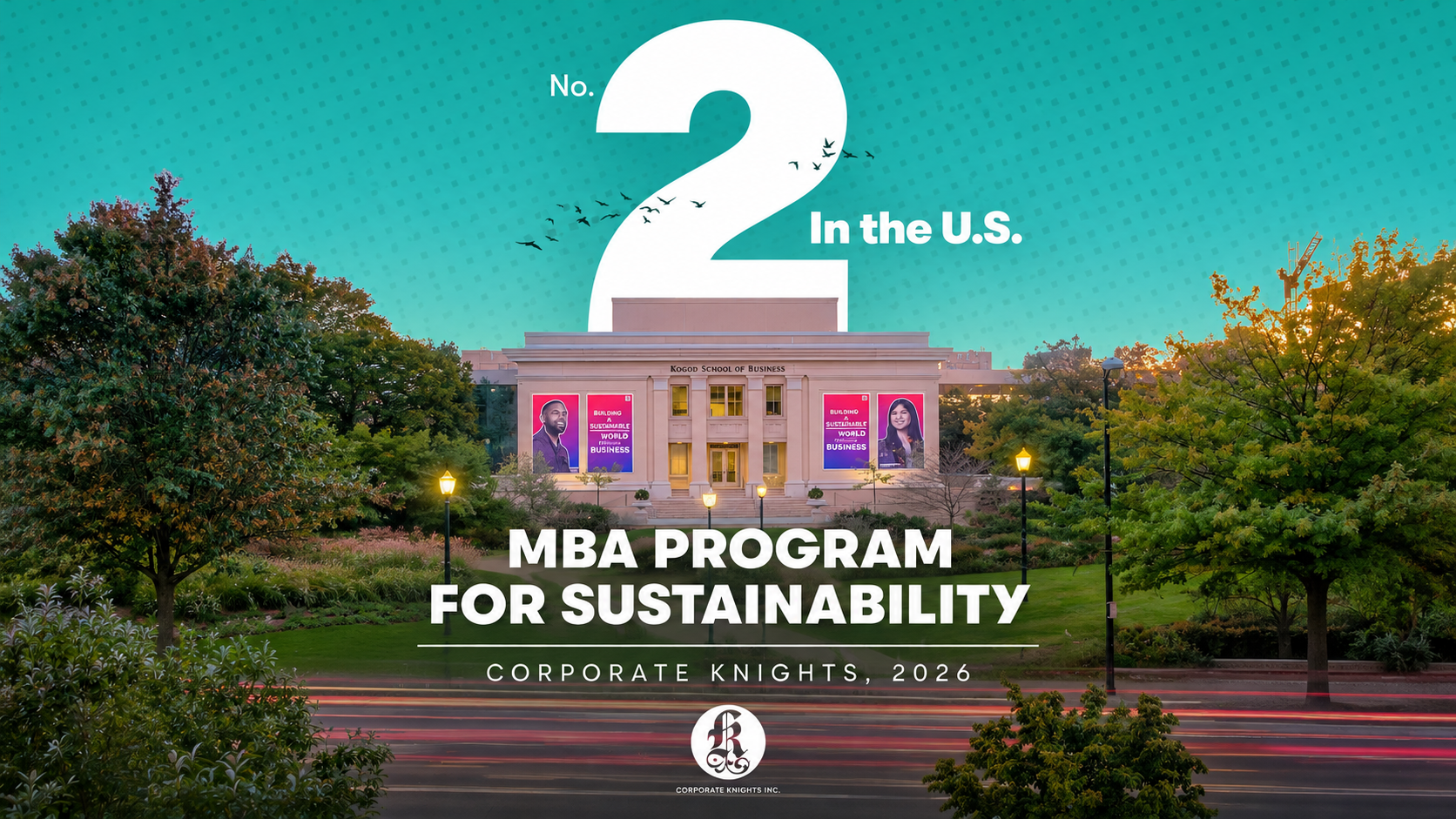
Corporate Knights has ranked American University’s Kogod School of Business full-time MBA No. 2 in the US and No. 5 in the world in its 2026 Better World MBA ranking. Kogod moved up one place among US programs from No. 3 last year and held its No. 5 global position. In 2024, it ranked No. 12 globally.
Corporate Knights grades MBA programs on what they require every student to learn. Eighty percent of the score measures how deeply sustainability runs through the core curriculum. The other 20 percent tracks whether graduates go on to do sustainability work. This year's ranking evaluated 179 business schools. Kogod's result rests on two things: our curriculum and our alumni.
"Sustainability works when it's built into how an organization functions, from strategy to the supply chain," said Nicole Darnall, Arlene R. and Robert P. Kogod Eminent Scholar Chair in Sustainability, who holds a joint appointment in Kogod and AU's School of Public Affairs. "We build sustainability into core business education, so our students treat environmental and social responsibility as part of every strategic decision."
Sustainability in the Core Curriculum
Every Kogod MBA student takes Sustainability Strategy, one of two required advanced professional skills courses, alongside a business core in accounting, finance, statistics, operations, management, and marketing. The program ends with Strategic Decision Making, a capstone consulting project with a strong sustainability emphasis. Students who want to go further can pair the MBA with an MS in Sustainability Management. Students also work with companies and nonprofits on ESG reporting, carbon accounting, and impact measurement.
"Our faculty have spent years building sustainability into the MBA curriculum because they care about teaching it well," said Casey Evans, interim dean of the Kogod School of Business. "And our students come here wanting it. They see sustainability as part of how business gets done, and they push us to keep going further."
Employers are seeking out that mix of business and sustainability expertise. In a 2026 Kogod survey of more than 300 professionals across 20-plus industries, led by Julie Anderson, director of the MS in Sustainability Management, 69 percent said they would hire for sustainability skills in roles outside dedicated sustainability positions. Among respondents who favored either business acumen or technical sustainability knowledge, 62 percent chose business acumen. Companies are also tracking the payoff: half of respondents measure revenue from sustainable products and services, and 43 percent measure cost savings and operational efficiency.
A Sustainable University
Kogod's work is part of a university-wide commitment. In 2018, American University became the first US university, first urban campus, and first research university to achieve carbon neutrality, two years ahead of its goal. The Alan and Amy Meltzer Center for Athletic Performance, AU’s first LEED Platinum building, runs fully electric on rooftop solar and geothermal energy and won a 2026 Clean Energy DC Award. The Princeton Review ranks AU No. 2 on its Top 50 Green Colleges list, and AASHE's 2025 Sustainable Campus Index named AU a top performer, including No. 2 in energy and climate. Kogod students see this work up close: every first-year student takes a sustainability tour of campus, and incoming graduate students meet with AU’s sustainability staff during orientation, connecting what they learn in the classroom to what is happening on campus.
Kogod's research also takes on one of the biggest levers organizations have: what they buy. Procurement accounts for more than a third of global GDP, and the school's Sustainable Procurement Research Initiative studies how purchasing decisions can cut emissions across supply chains. The initiative has produced more than 110 publications, works with 25 global research fellows and affiliates, and is supported by partners including the UN Environment Programme and the National Science Foundation. In September, Kogod faculty, including Darnall, published a report on expanding sustainable procurement at AU itself.
Students also run their own sustainability journal. Every article in the Kogod Sustainability Review is selected, edited, fact-checked, and peer-reviewed by a student editorial board, which also manages the publication's business side and promotion. This year's seventh volume features work from AU undergraduates, graduate students, and alumni on climate risk and insurance, how corporations can invest in community resilience, and a project turning skateboard waste into a circular business from the DMV to Kenya.
A Strong Fall for Kogod
The Corporate Knights ranking caps a fall of gains for Kogod. In September, Bloomberg Businessweek ranked the full-time MBA No. 33, its highest on record, and No. 6 in the nation for learning. QS ranked Kogod No. 40 among US programs, also a record. U.S. News & World Report placed Kogod's undergraduate program in the top 10 for international business, and Billboard named Kogod's Business & Entertainment program a Top Music Business School for the fourth year running.
"Rankings are an imperfect measure, and no single one tells the whole story," Evans said. "But when rankings built in very different ways keep moving in the same direction, that's momentum. It comes from the work our faculty, staff, and students put in every day."